December 16, 2025

The Complete Zone 2 HYROX Running Training Guide You Need With Pacing & Intervals

Zone 2 training boosts HYROX performance by improving aerobic efficiency, recovery, and energy preservation, helping athletes maintain power and pacing throughout the race.

Unlock Your HYROX Potential with Zone 2 Training

Ready to enhance your race-day performance? Discover how Zone 2 training can revolutionize your endurance, recovery, and overall fitness. Start building the aerobic base you need for long-term gains in HYROX.

If you’ve finished a HYROX race with your heart rate pinned near max for over an hour and thought, “At least I know I can suffer,” you’re not alone.

‍

Scroll through any HYROX forum and you’ll see the same story repeated:

  • Strong athletes stuck at the same race time
  • Heart rate spiking within the first kilometer
  • Heavy breathing through stations that should feel manageable
  • Confusion about whether Zone 2 training is actually worth the time

The short answer?

‍
Yes and it’s probably the most overlooked tool in HYROX training.
‍

TL;DR

  • Zone 2 training builds the aerobic base that lets HYROX athletes sustain effort across long runs and repeated stations.
  • It improves fat utilization and preserves glycogen for high-demand movements like sleds, lunges, and wall balls.
  • Strong Zone 2 fitness makes hard efforts feel more controllable by improving recovery and lactate clearance.
  • Zone 2 work supports strength and intensity training. It doesn’t replace it, it enables it.
  • ChAIron’s HYROX plans balance Zone 2 volume with targeted strength, intervals, and race-specific work for long-term gains.
    ‍

Why HYROX Feels Brutal Even for Fit Athletes

‍

HYROX sits in a unique physiological space.

‍

It’s not a sprint.
It’s not a marathon.
It’s a long, sustained effort where most athletes operate near lactate threshold for 60–90 minutes, with repeated spikes from strength-based stations.

‍

What this means in practice:

  • You’re running close to your aerobic ceiling
  • Strength work happens while oxygen-deprived
  • Poor aerobic efficiency shows up early and compounds fast

‍

This is why many athletes can push through a race but don’t actually get faster year to year.

‍

What Zone 2 Training Actually Does (Beyond “Easy Cardio”)

‍

Zone 2 training is often misunderstood as slow, low-value mileage. In reality, it drives deep physiological adaptations that HYROX demands.

‍

‍

1. It Builds Aerobic Infrastructure

‍

Zone 2 increases both the number and efficiency of mitochondria in your muscle cells.
More mitochondria = more energy production with less stress.

In HYROX terms:

  • Your heart rate climbs more slowly
  • Running feels easier at the same pace
  • Recovery between stations improves

2. It Improves Fuel Efficiency

‍

At Zone 2 intensity, your body relies more on fat oxidation and less on glycogen.

Why this matters:

  • Glycogen is limited
  • Once it runs low, heart rate spikes and pace collapses

Zone 2 trains your body to spare carbohydrates, so you can still perform late-race efforts when others fade.

‍

3. It Makes Threshold Work Sustainable

‍

Many HYROX athletes live in high-intensity training zones ,  intervals, tempo runs, race simulations.

Without an aerobic base:

  • Threshold work feels chaotic
  • Intervals become survival sessions
  • Heart rate stays elevated even at moderate paces

Zone 2 doesn’t replace hard training ,  it makes it usable.

‍

Why Zone 2 Training Supports HYROX Strength (Not Replaces It)

‍

While HYROX is often perceived as a high-intensity race, performance over 60–90 minutes depends heavily on aerobic efficiency. This is where Zone 2 training plays a critical supporting role in strength development.

‍

Zone 2 work builds the aerobic base that allows athletes to:

  • Sustain power output during long efforts
  • Recover faster between strength-heavy stations
  • Keep heart rate under control during compromised runs
  • Preserve glycogen for sleds, wall balls, and lunges

For HYROX athletes, Zone 2 training doesn’t make you weaker. It makes your strength usable deeper into the race.

‍

How Zone 2 Strengthens Race-Day Performance

‍

Zone 2 training improves:

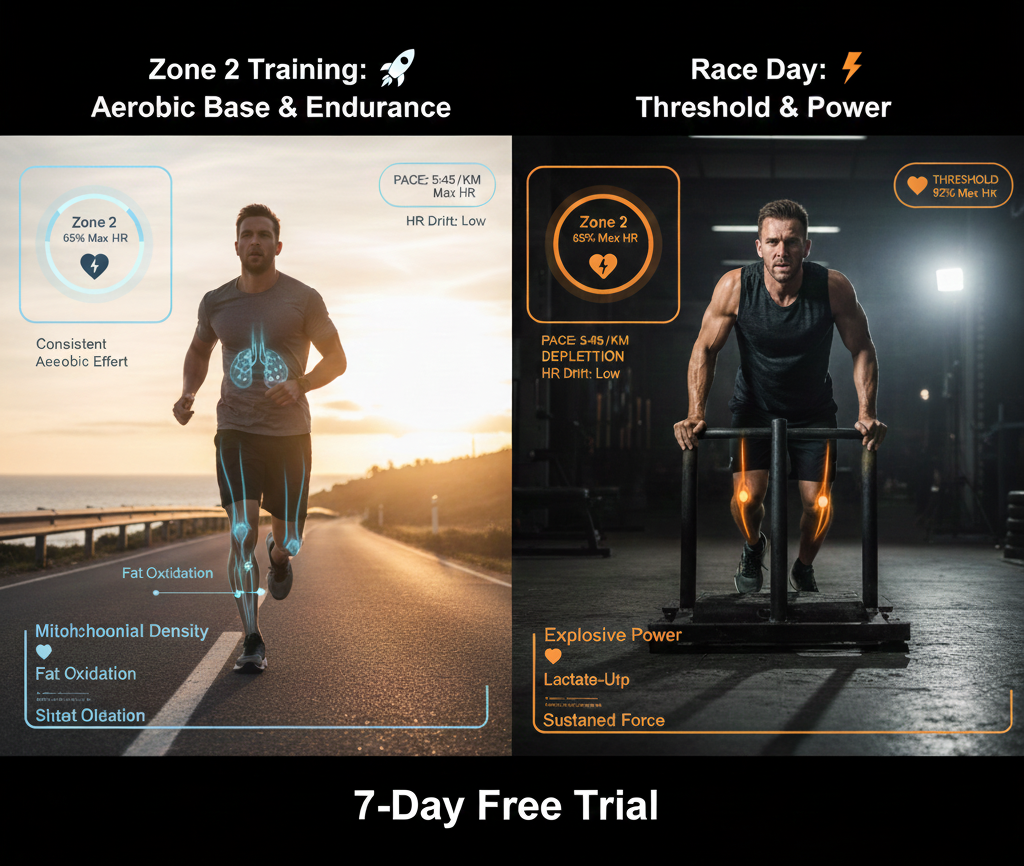
  • Mitochondrial density, increasing energy production efficiency
  • Fat oxidation, reducing early glycogen depletion
  • Lactate clearance, helping heart rate drop faster after stations

This means athletes arrive at each station less fatigued, maintain cleaner movement patterns, and avoid redlining early — one of the most common causes of stalled HYROX progress.

‍

Sample Zone 2 Sessions for HYROX Athletes

‍

These sessions integrate seamlessly alongside strength and conditioning work and can be used year-round.

‍

1. Long Zone 2 Run

‍

Purpose: Aerobic base + race durability

  • 60–90 minutes at 60–70% max HR
  • Conversational pace or nasal breathing
  • Priority on duration, not speed

2. Incline Zone 2 Walk

‍

Purpose: Low-impact aerobic volume

  • Treadmill incline: 5–10%
  • Brisk walking pace
  • 45–75 minutes staying firmly in Zone 2

Ideal for recovery days or athletes prone to overuse injuries.

‍

3. Zone 2 Bike or Erg Session

‍

Purpose: Aerobic capacity without joint stress

  • Bike, rower, or ski erg
  • 45–75 minutes continuous
  • Heart rate stays stable with no intensity spikes

Best paired after heavy lower-body strength days.

‍

4. HYROX-Specific Zone 2 Hybrid Circuit

‍

Purpose: Teach recovery between efforts

Example:

  • 5 min Zone 2 run
  • 20 bodyweight lunges
  • 5 min Zone 2 run
  • 20 light wall balls
  • Repeat for 45–60 minutes

Key rule: heart rate must return to Zone 2 quickly after each movement.

‍

5. Active Recovery Zone 2 Session

‍

Purpose: Improve recovery and movement quality

  • 30–45 minutes easy Zone 2 cardio
  • Focus on relaxed breathing and cadence

Common Zone 2 Mistakes HYROX Athletes Make

  • Training “comfortably hard” instead of truly easy
  • Chasing pace instead of heart rate
  • Skipping Zone 2 work during race season
  • Doing too little total aerobic volume

Most athletes unintentionally train too hard, drifting into Zone 3 and missing the aerobic adaptations that actually improve race performance.

‍

How Zone 2 Fits Into a Strength-Focused HYROX Plan

‍

Zone 2 training should account for 60–70% of total weekly volume, with intensity layered strategically through:

  • Strength days
  • Interval runs
  • Race simulations

As aerobic efficiency improves, athletes can lift heavy, run faster, and recover quicker, without accumulating excessive fatigue.

‍

Why ChAIron Approaches Zone 2 Differently

‍

ChAIron doesn’t treat Zone 2 as generic “easy cardio.” It treats Zone 2 as the place of strength development by

  • Anchoring zones to individual thresholds, not age-based formulas
  • Adjusting volume based on race timeline and fatigue history
  • Integrating aerobic work to support strength under fatigue
  • Using Zone 2 strategically to reduce heart-rate drift on race day

The goal isn’t to train slower, it’s to make race pace feel easier.

⇒ Download ChAIron for free today

‍

The Real Takeaway

‍

Most HYROX athletes don’t need more grit.
They don’t need more suffering.

‍
They need more aerobic efficiency.

‍

Zone 2 training:

  • Raises the floor of performance
  • Makes strength usable late in the race
  • Turns hard efforts into controlled efforts

If HYROX feels harder than it should, and your times aren’t improving, Zone 2 might be the missing link.

‍

conclusion

Zone 2 training is a game-changer for HYROX athletes. It builds the aerobic foundation needed to sustain effort, recover quickly, and perform stronger during high-intensity stations. By integrating Zone 2 work into your training, you can improve endurance, reduce fatigue, and make race-day efforts more controlled. It’s not about training slower—it’s about making hard efforts feel easier and unlocking your full potential. Start incorporating Zone 2 today and watch your HYROX performance soar.

Maximize Your HYROX Performance with ChAIron's Plan

Let ChAIron guide you through a personalized, Zone 2-focused training plan that perfectly balances endurance, strength, and race-specific work. Improve your pacing, reduce fatigue, and hit new personal bests.

Master Your Fitness Journey – Read More