December 23, 2025

Back squatting your bodyweight? Solid work.
But lifting your entire body against gravity, pulling off a muscle-up, holding a human flag, or floating into a handstand, that takes a different level of strength, control, and pure athletic mastery.
That’s calisthenics.
A form of bodyweight training that looks simple on the surface… until you realise it can take you from basic push-ups all the way to gravity-defying skills.
No fancy machines.
No plates.
Just you, your bodyweight, and the discipline to build real strength.
In this guide, you’ll learn how to start calisthenics from scratch, the essential beginner exercises, how to warm up properly, and expert tips from our fitness experts at ChAIron.
No, we are not going to bore you by saying the etymology of the word, or jumping into a long scientific lecture about what Calisthenics is.
The word calisthenics has its origin from the Greek words ‘kallos’ and ‘sthenos’ (meaning: beauty and strength) and is mainly used as a strength-building tool by the ancient Greeks.
Spartan warriors, Shaolin monks and pretty much every warrior clan we know have used Calisthenics as a part of their training strategy.
When you train with calisthenics, you are working with your own body as resistance. That makes it one of the most accessible and versatile ways to build strength, whether you train at home, in a gym, or on the road.
Here’s what makes calisthenics especially valuable for athletes and everyday fitness enthusiasts.
You don’t need barbells, machines, or fancy setups to get started. Your bodyweight is enough to build strength, coordination, and control. If you want to progress later, you can add tools like resistance bands, pull-up bars, or weights, but they are optional, not mandatory.
Calisthenics may not always feel like a long run or bike ride, but many movements elevate your heart rate and challenge your endurance. Over time, this contributes to better cardiovascular fitness and overall health, especially when exercises are performed in circuits or higher-rep formats.
Missed the gym?
Traveling?
Running short on time?
Calisthenics lets you stay consistent no matter your schedule. You can train your full body using minimal space and still see meaningful progress.
Here are some of the core differences between Calisthenics and Weightlifting
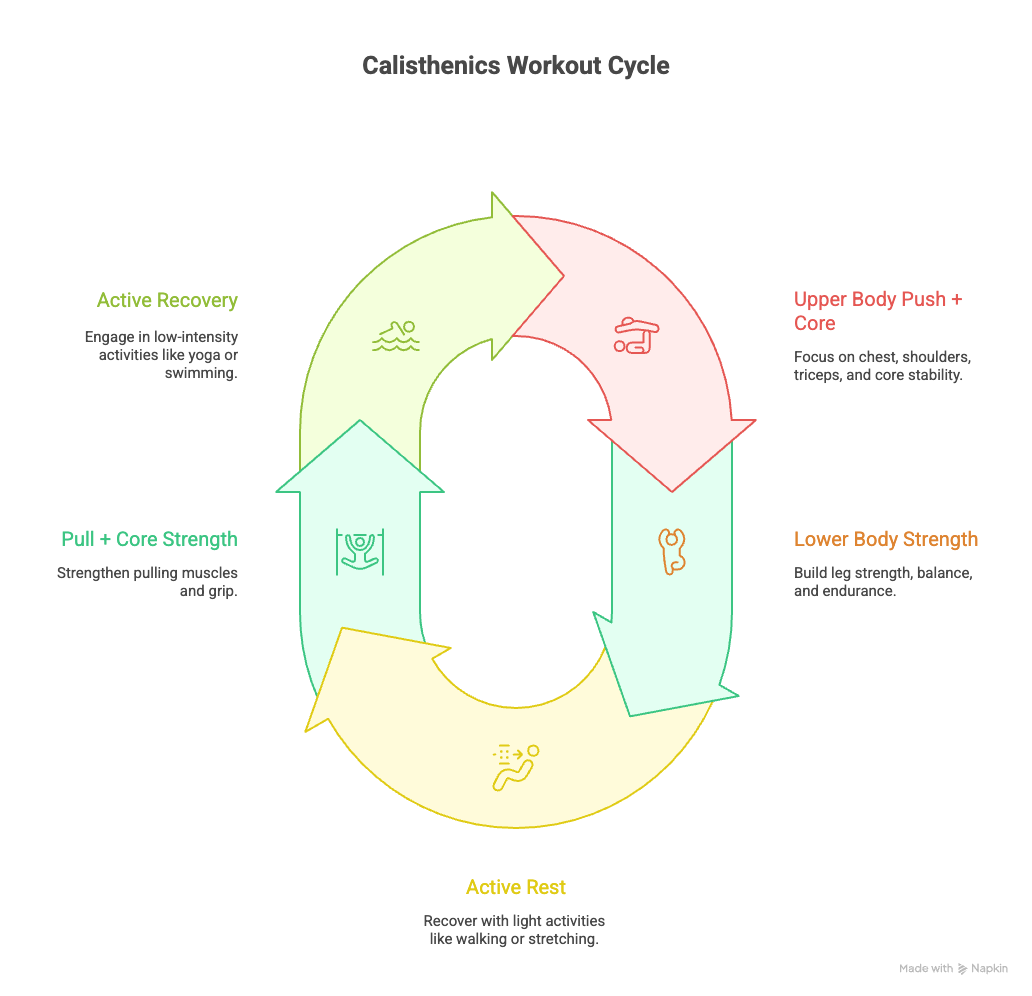
This calisthenics workout plan is built entirely from exercises available in the Chairon library. You will train pushing, pulling, legs, core, and full-body coordination using bodyweight movements that develop real strength and control.
You can follow this plan whether you train at home, in a gym, or outdoors. Always warm up properly before starting.
Always take time to warm up before each session.
This session focuses on pushing strength through the chest, shoulders, and triceps, while reinforcing core stability.
Structure: Perform 3 rounds total. Rest: 60–90 seconds between each full round.
Chairon’s form and technique tips
To get the most out of these movements, focus on the following technical cues:
This workout builds leg strength, balance, and endurance using foundational lower-body calisthenics movements.
Structure: Perform 3 rounds total. Rest: 60–90 seconds between each full round.
Use this day to recover. Light walking, mobility work, or gentle stretching is encouraged. This helps you come back stronger for the next sessions.
This routine focuses on your "pulling" muscles and grip strength. In the context of HYROX, this is the specific strength you need for the Sled Pull and maintaining your hold during the Farmer’s Carry.
Structure: Perform 3 rounds total. Rest: 60–90 seconds between each full round.
ChAIron tip: If pull-ups are challenging, focus on Australian rows and dead hangs until your strength improves.
Use this day to stay moving without pushing intensity. Walking, yoga, swimming, or foam rolling all help support recovery while keeping you active.
CTA: For more workouts tailored to your fitness needs, guided progress and nutrition requirements, download the ChAIron app for free today
⇒ See these exercises inside the ChAIron app
Your body is the main tool in calisthenics, but the right gear can make training more comfortable and effective.
Yes. This calisthenics workout plan works well for beginners because it uses simple bodyweight exercises with easy progressions. You can start with modified movements like incline push-ups and Australian rows, then increase difficulty as you get stronger.
Yes. You can follow this calisthenics workout plan at home using only your bodyweight. Most exercises require no equipment, and optional tools like a pull-up bar or rings can be added later for progression.
You should do a calisthenics workout plan three to five days per week. Beginners usually start with three days, while more experienced athletes can train four to five days as long as recovery is managed properly.
Yes. Calisthenics builds muscle without weights by using progressive overload through higher reps, slower tempo, longer holds, and more advanced exercise variations like pull-ups, dips, and single-leg squats.
Yes. A calisthenics workout plan is effective long term because exercises scale from basic movements to advanced skills like handstands, muscle-ups, and levers, allowing continuous strength and skill progression.
.png)
.png)