November 24, 2025
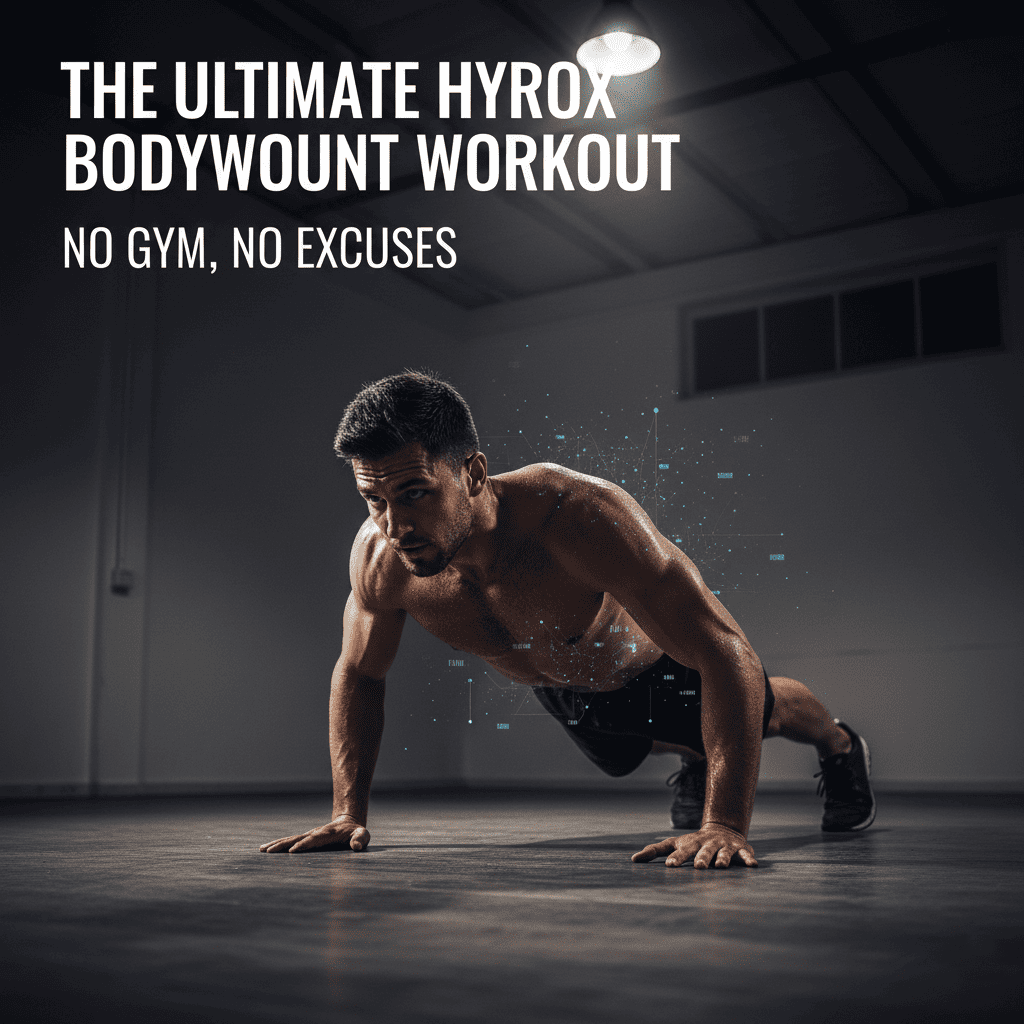
Harry Bullmore, a fitness writer, decided to swap his usual gym routine for a Hyrox bodyweight session.
Without a single piece of equipment, no sleds, no rowing machines, and no heavy weights, he set out to see if he could simulate the intensity of the "World Series of Fitness Racing."
He started his timer and took off on a 1km run through a woodland trail. When he returned, he dropped for burpees and lunges on the wet ground. What he expected to be a simple holiday workout turned into a 33-minute battle against what athletes call compromised running- the heavy-legged feeling that hits when you try to run after taxing your muscles with functional moves.
His story proves a vital point: you don’t need a specialized gym to build a Hyrox-ready engine. You just need space, sweat, and a plan.
Hyrox is a global fitness race that usually takes place in massive indoor arenas. The standard format is simple but brutal: eight rounds of a 1km run, with each run followed by a specific functional workout station. These stations usually involve heavy equipment like sleds, rowing machines, and sandbags.
A bodyweight Hyrox workout replaces that heavy gear with movements that use your own weight as resistance.
According to Centr, about 60% of Hyrox success comes from cardiovascular endurance. By focusing on bodyweight moves like squats, lunges, and burpees, you can build the chassis (your strength) and the engine (your heart and lungs) needed to finish the race.
Statistics show that the challenge is worth it. A typical Hyrox competitor burns between 800 and 1,200 calories during a single race. Even without weights, the high-intensity nature of these movements keeps your heart rate in "Zone 4" (80-90% of your maximum) for the majority of the session.
Training for Hyrox at home or in a park has several benefits. First, it removes the barrier of expensive gym memberships. Second, it focuses on movement quality. Many beginners get injured by trying to push a 150kg sled before they have the proper leg strength or core stability.
Bodyweight training builds muscular endurance.
This is the ability of your muscles to keep working even when they are exhausted. In a real Hyrox race, you might have to perform 100 wall balls at the very end. Training with high-rep bodyweight squats prepares your nervous system for that late-game fatigue.
Since you won't have a 100kg sled or a SkiErg in your living room, you have to get creative. Here is how you can mimic the eight official stations using only your body and simple household items, as suggested by JLL Fitness:
You can use these routines created by Hyrox Master Trainers like Jade Skillen.
This is a classic simulation that builds endurance.
The Goal: Complete 5 rounds as fast as possible.
AMRAP stands for "As Many Rounds As Possible." Set a timer for 25 minutes and move through this circuit without stopping.
EMOM stands for "Every Minute on the Minute." This teaches you to work under a clock, which is vital for race day.
Repeat 5 times for a total of 25 minutes.
To get the most out of your bodyweight sessions, you should follow a few proven fitness principles. These help you balance your energy and build muscle faster.
In training, the 80/20 rule (also called the Pareto Principle) suggests that 80% of your results come from 20% of your efforts. In Hyrox, this means focusing on the movements that matter most: running and leg strength.
Another way to use this rule is for intensity. Spend 80% of your training time on easy cardio (Zone 2) where you can still hold a conversation. Spend the remaining 20% on high-intensity sprints or heavy circuits. This prevents burnout while still building a massive gas tank.
Created by strength coach Charles Poliquin, this method helps build muscle size and endurance simultaneously. You pick three exercises for the same muscle group and do them back-to-back:
Training for Hyrox doesn't require a specialized facility. By using the bodyweight adaptations for the eight stations and following structured workouts, you can prepare yourself for the starting line from your own home.
Staying consistent with your running and mastering your bodyweight form is the fastest way to a personal best.
As the data shows, you are likely to burn nearly 1,000 calories and join a community of athletes who have discovered that fitness is about what your body can do, not just how much weight you can lift. Grab your shoes, find a patch of grass, and start your first 1km run today.
.png)
.png)