December 16, 2025
If you’ve finished a HYROX race with your heart rate pinned near max for over an hour and thought, “At least I know I can suffer,” you’re not alone.
Scroll through any HYROX forum and you’ll see the same story repeated:
The short answer?
Yes and it’s probably the most overlooked tool in HYROX training.
HYROX sits in a unique physiological space.
It’s not a sprint.
It’s not a marathon.
It’s a long, sustained effort where most athletes operate near lactate threshold for 60–90 minutes, with repeated spikes from strength-based stations.
What this means in practice:
This is why many athletes can push through a race but don’t actually get faster year to year.
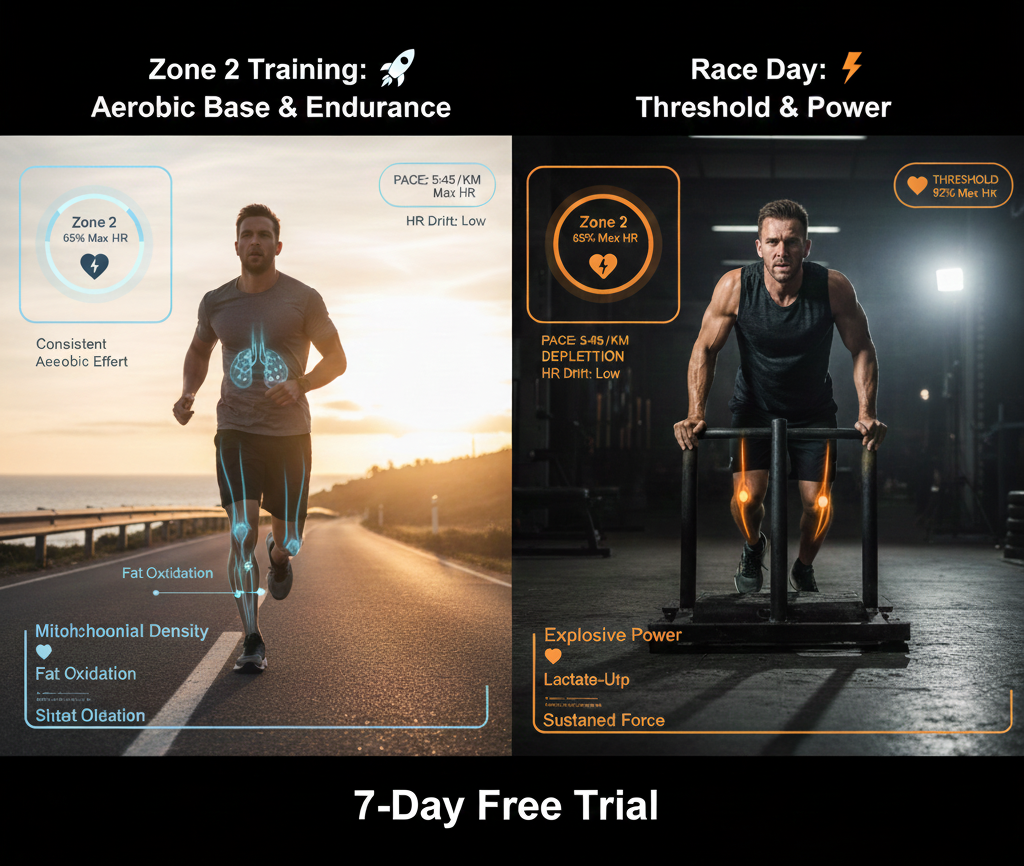
Zone 2 training is often misunderstood as slow, low-value mileage. In reality, it drives deep physiological adaptations that HYROX demands.
Zone 2 increases both the number and efficiency of mitochondria in your muscle cells.
More mitochondria = more energy production with less stress.
In HYROX terms:
At Zone 2 intensity, your body relies more on fat oxidation and less on glycogen.
Why this matters:
Zone 2 trains your body to spare carbohydrates, so you can still perform late-race efforts when others fade.
Many HYROX athletes live in high-intensity training zones , intervals, tempo runs, race simulations.
Without an aerobic base:
Zone 2 doesn’t replace hard training , it makes it usable.
While HYROX is often perceived as a high-intensity race, performance over 60–90 minutes depends heavily on aerobic efficiency. This is where Zone 2 training plays a critical supporting role in strength development.
Zone 2 work builds the aerobic base that allows athletes to:
For HYROX athletes, Zone 2 training doesn’t make you weaker. It makes your strength usable deeper into the race.
Zone 2 training improves:
This means athletes arrive at each station less fatigued, maintain cleaner movement patterns, and avoid redlining early — one of the most common causes of stalled HYROX progress.
These sessions integrate seamlessly alongside strength and conditioning work and can be used year-round.
Purpose: Aerobic base + race durability
Purpose: Low-impact aerobic volume
Ideal for recovery days or athletes prone to overuse injuries.
Purpose: Aerobic capacity without joint stress
Best paired after heavy lower-body strength days.
Purpose: Teach recovery between efforts
Example:
Key rule: heart rate must return to Zone 2 quickly after each movement.
Purpose: Improve recovery and movement quality
Most athletes unintentionally train too hard, drifting into Zone 3 and missing the aerobic adaptations that actually improve race performance.
Zone 2 training should account for 60–70% of total weekly volume, with intensity layered strategically through:
As aerobic efficiency improves, athletes can lift heavy, run faster, and recover quicker, without accumulating excessive fatigue.
ChAIron doesn’t treat Zone 2 as generic “easy cardio.” It treats Zone 2 as the place of strength development by
The goal isn’t to train slower, it’s to make race pace feel easier.
⇒ Download ChAIron for free today
Most HYROX athletes don’t need more grit.
They don’t need more suffering.
They need more aerobic efficiency.
Zone 2 training:
If HYROX feels harder than it should, and your times aren’t improving, Zone 2 might be the missing link.
.png)
.png)