December 24, 2025

The Murph workout is one of the most iconic and demanding workouts in the CrossFit world. Known for its intensity, mental toughness, and meaning, Murph is not just another CrossFit workout. It is a tribute, a test of endurance, and a true hero workout.
But here’s the truth many beginners do not hear clearly enough.
Murph is not meant to be done RX on day one.
If you are new to CrossFit, returning after a break, or still building basic strength and endurance, the smartest way to approach Murph is through scaling, patience, and progression.
This guide breaks down what Murph is, who should avoid RX Murph for now, how to scale it safely, and how to build toward it without risking injury.
The Murph workout, also called the Murph challenge, is performed every year on Murph Day in honor of Lieutenant Michael P. Murphy, a Navy SEAL who was killed in action in Afghanistan.
The workout consists of the entire workout below:
Traditionally, the workout is done wearing a weight vest or weighted vest, sometimes referred to as body armor, weighing 20 lbs for men and 14 lbs for women.
Murph is designed to test physical capacity, grit, and mental toughness. For CrossFit athletes with years of training, it is a familiar challenge. For beginners, it can quickly become a grueling workout if approached incorrectly.
RX Murph is not a beginner benchmark. You should avoid doing it unscaled if:
Jumping straight into RX Murph increases the risk of overuse injuries, shoulder and elbow strain, and in rare but serious cases, rhabdomyolysis. This does not mean Murph is off-limits. It means Murph should meet you where you are.
One of the biggest misconceptions around the Murph workout is that it must be done in one strict, unbroken format to “count.” That’s simply not true. In fact, Ben Dziwulski, CEO and head coach at WODPrep, provides the following tips
For many athletes, breaking Murph into rounds allows for better pacing, cleaner movement, and reduced injury risk. One of the most popular and effective structures is:
This setup distributes pushing volume more evenly and helps prevent early fatigue in the shoulders and elbows.
Other solid options include:
All of these formats complete the full Murph volume while allowing you to manage intensity more intelligently.
Murph is meant to be a tribute, not a test of ego.
If scaling the workout helps you move safely, maintain good form, and finish with intention, then scaling is the right choice. That might mean banded pull-ups, push-ups from the knees, reduced reps, or modified running distances.
The goal of Murph is to honor those who gave their lives in service, not to chase an RX label or compete with the people next to you. Finishing the workout healthy, present, and respectful matters far more than how it looks on paper.
If completing the full volume or movements compromises your form or recovery, adjust without guilt:
The priority is finishing the workout healthy, controlled, and respectful of its intent, not proving anything.
Murph is meant to be challenging, but it should never be reckless.
Training for Murph is not a one-week plan. A proper murph workout training plan builds capacity gradually.
This approach prepares both beginner and intermediate athletes to handle Murph safely.
Murph isn’t about rushing reps or chasing RX at all costs. It’s about preparation, consistency, and honoring the intent of the workout.
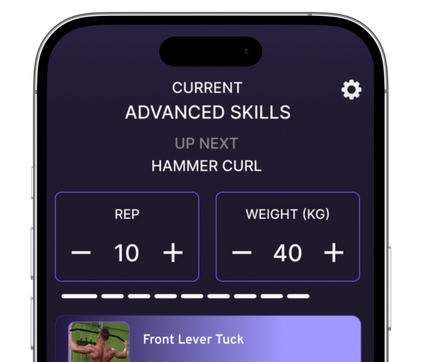
That’s exactly where Chairon comes in.
With Chairon, you can:
If you’re building toward Murph over weeks and not rushing it in one day, ChAIron helps you increase your volume, form, and reduce fatigue systematically, without exhausting your body.
Murph honors Lieutenant Michael Murphy, not reckless decision-making. The spirit of the workout is commitment, discipline, and respect for the process.
Whether you complete a scaled version, a half Murph, or your own beginner-friendly format, you are still participating in the tradition.
Done right, Murph can become your favorite workout milestone. Done wrong, it can set you back weeks or months.
Train smart. Scale with intention. Build patiently. That is how Murph is meant to be approached.
Yes. Beginners should scale the Murph by reducing reps, shortening the runs, and modifying movements like pull-ups and push-ups to avoid injury.
For beginners, finishing under 60–75 minutes (scaled) is solid. Time matters far less than completing it safely with good form.
Common scaling options include a Half Murph, Mini Murph, partitioning reps (5-10-15), or substituting pull-ups with ring rows and push-ups with incline or knee push-ups.
No. The weight vest is optional and not recommended for beginners. Most first-time athletes should do Murph without a vest.
Ideally, give yourself 4–8 weeks of preparation focusing on running endurance, pull-up strength, push-up volume, and squat capacity.
.png)
.png)