January 7, 2026

You've probably followed the same chest routine for months.
Same exercises.
Same sets and reps.
Maybe you switch between barbell and dumbbell work, or alternate between high and low rep ranges, but the structure stays static.
And at first, it works. Your chest responds. You get stronger. But then, something shifts.
Progress stalls.
You're going through the motions.
Your energy on Monday feels completely different from Wednesday, but your program demands the same effort both days. You're fatigued from a brutal leg session yesterday, but today's chest workout doesn't take that into account.
The problem isn't your work ethic, it's that most chest workouts are designed in isolation, divorced from your actual recovery, fatigue levels, and changing context.
This guide walks you through the real principles of chest programming, why static plans inevitably fail, and how intelligent adaptation transforms results.
✓ Chest programming must match your actual goal (hypertrophy, strength-endurance, maintenance)
✓ Fatigue windows and recovery capacity fluctuate, static programs can't account for this
✓ Your training context matters (single-sport vs. hybrid, available recovery time, life stress)
✓ Static programs fail because they don't adapt to your changing state
✓ Adaptive programming maintains stimulus while respecting recovery, preventing burnout and plateaus
✓ The best chest workout isn't the one you planned, it's the one that matches your actual readiness today
.png)
Chest training isn't one-size-fits-all. Your programming needs to match your actual goal.
Why This Works: Moderate rep ranges create both mechanical tension and metabolic stress, the two primary drivers of hypertrophy. Higher volume ensures sufficient muscle damage for growth.
Why This Works: Lower reps at high intensity build raw strength. Higher reps under fatigue simulate race or sport conditions, improving performance when tired.
Why This Works: Maintenance training prioritizes CNS recovery and hormonal balance while preserving neuromuscular gains.
Here's where static programs break down: they ignore recovery capacity.
Your body's ability to handle chest volume isn't constant. It fluctuates based on sleep, stress, nutrition, and previous training sessions.
Simply put, your body's ability is directly proportional to your lifestyle.
After any intense training session, you enter a fatigue window, a period where your central nervous system (CNS) and muscles are compromised. This window typically lasts 24-72 hours depending on intensity.
When you're in a deep fatigue window from previous sessions:
A static program that assigns the same volume every Tuesday, regardless of Monday's leg session or Friday's conditioning work, is gambling with your progress.
Here's a real-world example:
Let us assume that you workout in a gym regularly and follow a static workout session that goes like this:
Your legs are still recovering. Your CNS is taxed. Cortisol is elevated. Your body literally cannot recover from 15 additional chest sets without sacrificing results elsewhere.
So, what's the intelligent approach that's followed by ChAIron?
Assess your recovery status and adjust volume accordingly. Maybe Tuesday becomes 10 sets instead, maintaining stimulus without unnecessary fatigue accumulation.
Your chest programming also needs to reflect your broader training context.
If chest is your primary focus, you can afford higher frequency and volume. You're not competing the next weekend in an endurance event. Recovery resources can be directed toward chest adaptation.
Chest work is important, but it's one piece of a much larger puzzle. You're also building aerobic capacity, running power, grip strength, and work capacity. A high-volume chest routine that compromises your ability to recover for next week's interval training is counterproductive.
If you are preparing for a HYROX event, you can check out ChAIron's HYROX hub below
If you're training 4-5 days per week around a full-time job, your recovery capacity is genuinely lower than an athlete whose job is training. Static programs designed for someone with 8+ hours of sleep and nutritional control won't work for you.
You've now seen the principles. You understand hypertrophy, strength-endurance, fatigue windows, and context. So why do people stick with static programs?
Because it's simple. You write a program, you follow it, and you don't have to think.
But simplicity comes with a cost: stagnation.
A static program makes assumptions:
None of these are true. Here's what will realistically happen:
If you are interested in following a dumbbell chest workout at your home or your gym, you can check out our ultimate dumbbell chest workout guide here
The program prescribes 14 sets when your body can only recover from 10. The extra 4 sets create fatigue without stimulus, draining your central nervous system.
Your prescribed working weights are based on your peak performance. But you're not always at peak. A static program ignores form degradation and forces you to chase numbers that shouldn't be chased today.
Your program doesn't know you ran a 10k yesterday or deadlifted heavy today. It just demands: "Chest day."
Static programs are written once and followed robotically. There's no check-in mechanism. You can struggle for weeks before adjusting anything.
When progress stalls, static programs offer no guidance. Do you add volume? Reduce intensity? Take a deload? You're left guessing.
Your program might prescribe 8-10 reps for strength building, but on a fatigued day, reaching that rep range with good form might be impossible. A static program has no backup plan.
So, what will be the solution to all these bottlenecks?
Choosing Adaptive Programming that fits for you and not vice-versa
Intelligent programming systems work by evaluating three critical data points:
Before each session, the system assesses your readiness. This comes from:
If fatigue is elevated, volume is automatically reduced while maintaining stimulus. You might do 10 sets instead of 15, but those 10 sets are positioned to drive adaptation without excessive CNS drain.
As you train, the system monitors:
If you're moving fast and controlling the eccentric, intensity can be increased. If bar speed drops or form breaks, the system scales back immediately, preventing overreaching.
The system tracks:
This context informs whether today's chest session should be strength-focused, hypertrophy-focused, or maintenance-focused.
.png)
Here's a concrete example of how ChAIron works using adaptive programming as its core.
Let us assume that you're doing a planned session of 4 sets of barbell bench press, 3 sets of dumbbell flyes, 3 sets of machine press (10 sets total)
ChAIron will first conduct a Pre-Workout Assessment, like this
System Decision: Reduce volume to 7-8 sets. Maintain intensity (heavy weight), but fewer total reps.
Session Execution:
Post-Workout Assessment:
Compare this to following a static program on the same day: You complete all 10 sets as written, despite being fatigued. Your form suffers on sets 7-10. Your CNS takes an unnecessary hit. You're now even more fatigued for tomorrow.
The adaptive approach: same stimulus, better recovery, faster progress.
The chest programming principles we've covered apply to your entire training.
The question then becomes: Who's managing this adaptation for you?
If you're manually tracking fatigue, adjusting volume in a spreadsheet, and making these decisions yourself, you're spending mental energy that could go toward actual training. You're also missing data, your phone doesn't know your resting heart rate unless you track it. Your spreadsheet doesn't know whether your form is degrading.
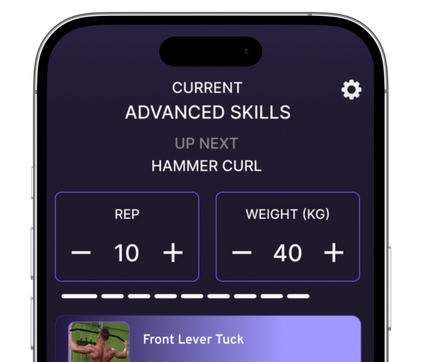
This is where ChAIron comes in. Equipped to handle adaptive programming for you, ChAIron is like your own pocket coach, 24*7. The difference between a great static program and ChAIron is the difference between rowing against the current and rowing with it.
The principles you've learned here, matching volume to recovery, adjusting for fatigue, respecting training context, these are the foundation of sustainable progress.
The next step is having a system that implements these principles automatically, in real-time, across all your training.
1. Why does my chest workout stop working after a few weeks?
Most chest programs stall because they are written once and never adjusted for changes in your recovery, fatigue, and lifestyle stress, so the same volume eventually becomes more punishment than stimulus.
2. How do I know if my chest training volume is too high?
If performance drops, joints ache more, and you stay sore for longer than 48–72 hours, your weekly chest volume likely exceeds what you can recover from given your current sleep, stress, and overall training load.
3. What is adaptive chest programming?
Adaptive chest programming adjusts sets, reps, and exercise selection in real time based on your readiness markers (sleep, fatigue, performance, and context) instead of forcing you to follow a fixed plan no matter how you feel that day.
4. Can I build my chest effectively if I also train for HYROX or other hybrid events?
Yes, but your chest work needs to be slotted around running, conditioning, and event-specific sessions, with volume and intensity scaled so it supports performance rather than adding junk fatigue that hurts your race prep.
5. How often should I change my chest routine to avoid plateaus?
Rather than overhauling exercises every 4–6 weeks, focus on ongoing micro-adjustments to load, volume, and effort based on fatigue and progress, so the program keeps evolving with you instead of becoming a static template.
.png)
.png)