December 17, 2025

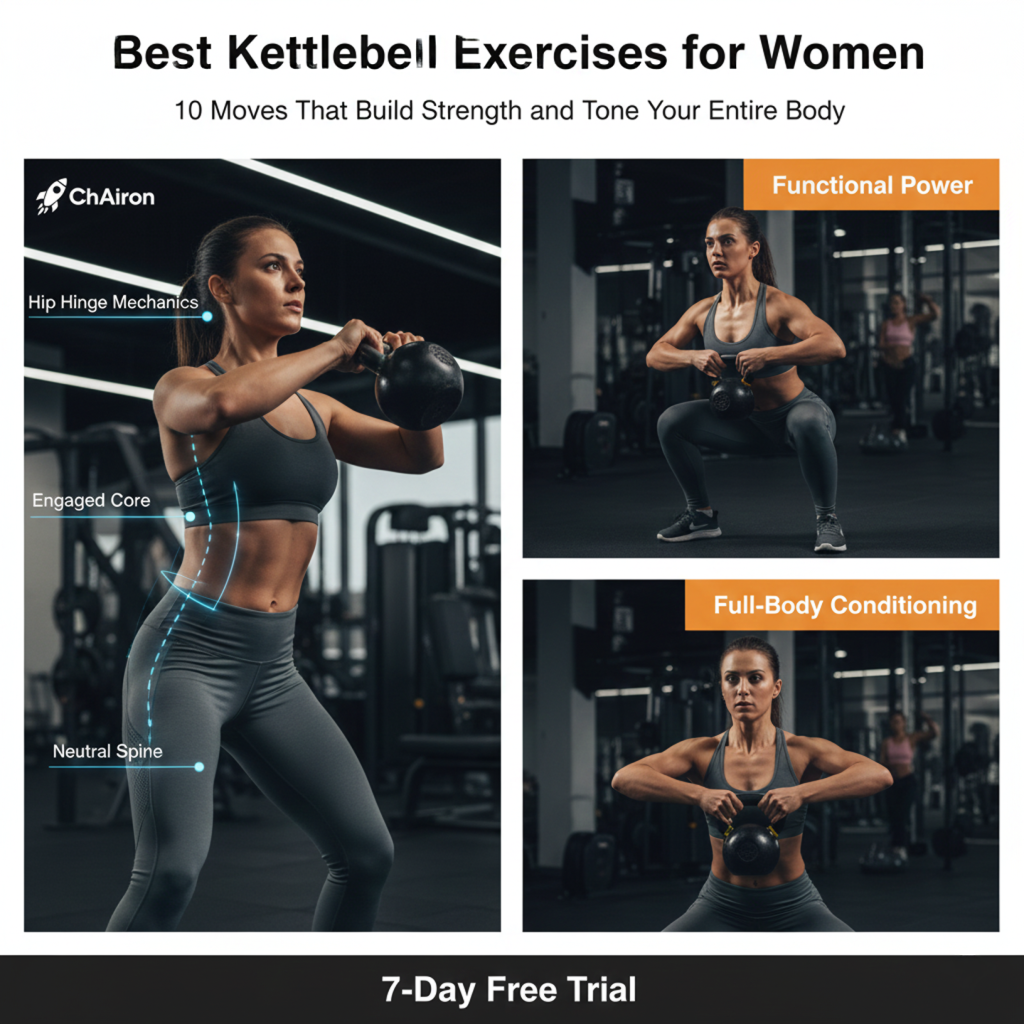
Best Kettlebell Exercises for Women: 10 Moves That Build Strength and Tone Your Entire Body

Kettlebells are one of the most versatile training tools for women. These 10 exercises build functional strength, sculpt muscle, improve mobility, and torch calories, all with one piece of equipment.

Ready to Transform Your Body with Kettlebells?

Start your kettlebell journey today with our top 10 exercises designed to build strength and tone your entire body. Whether you're at home or in the gym, these moves will help you get stronger and leaner—quickly!

Kettlebells have surged in popularity among women, and for good reason. This single piece of equipment delivers benefits that typical dumbbell or machine training can't match. Unlike traditional strength training where you isolate muscles, kettlebell exercises engage multiple muscle groups simultaneously. 

A kettlebell swing, for example, works your glutes, hamstrings, core, back, and shoulders in one explosive movement. This integration builds the kind of strength that translates to real life, carrying groceries, lifting children, climbing stairs, playing sports.

This guide breaks down the 10 best kettlebell exercises for women based on effectiveness, muscle activation, fat-burning potential, and real-world results from fitness experts and communities.

Choosing the Right Kettlebell Weight

Before going into exercises, you need to choose the right kettlebell weight for you. So, at ChAIron, we have given you a comprehensive list of kettlebell weights you can use as per your fitness level.

Beginner women (new to kettlebells or strength training):

  • Start with 8-12kg (18-26lbs)
  • Focus on mastering form with lighter weight
  • Progress weight gradually over weeks

Intermediate women (6+ months consistent training):

  • Use 12-16kg (26-35lbs) for most exercises
  • Some exercises (like Turkish get-ups) may require lighter weight
  • Have multiple weights available for different movements

Advanced women (1+ years consistent training):

  • Use 16-24kg (35-53lbs) for swings and lower body work
  • 12-16kg for upper body and skill movements
  • 8-12kg for warm-ups and mobility work

General rule: Choose a weight where the last 2-3 reps of a set feel challenging while maintaining perfect form. If your form breaks down, the weight is too heavy.

What makes kettlebell training unique

  • Dynamic, full-body movements that mimic real-life activities
  • Builds functional strength (not just isolated muscle groups)
  • Combines strength training with cardiovascular conditioning
  • Improves mobility, stability, and coordination
  • Burns significant calories while building lean muscle
  • Requires minimal space (perfect for home workouts)
  • Scalable for beginners to advanced athletes

Benefits specific to women:

  • Develops strong glutes, hamstrings, and posterior chain (improves posture, reduces back pain, shapes lower body)
  • Builds core stability that supports pelvic floor health
  • Creates lean, toned muscle without excessive bulk
  • Improves bone density (critical for preventing osteoporosis)
  • Enhances athletic performance and functional fitness for daily life
  • Time-efficient workouts (20-30 minutes delivers full-body training)

The Top 10 Best Kettlebell Exercises for Women

1. Kettlebell Swing (Two-Hand or Single-Arm)

Primary muscles: Glutes, hamstrings, core, back, shoulders

Why it's the best: The kettlebell swing is the foundational movement that makes kettlebell training unique. It's an explosive, hip-driven exercise that builds powerful glutes and hamstrings while burning massive calories. Often called the ultimate fat-torcher, swings elevate heart rate rapidly while sculpting the posterior chain.

How to perform two-hand kettlebell swings:

  • Stand with feet shoulder-width apart, kettlebell on ground between feet
  • Hinge at hips (push butt back), grab kettlebell with both hands
  • Hike kettlebell back between legs like a football snap
  • Explosively drive hips forward, swinging kettlebell to shoulder height
  • Let kettlebell swing back down between legs, hinging at hips again
  • Repeat in fluid, rhythmic motion

Critical form points:

  • Power comes from hip thrust, not arms (arms are just ropes)
  • Keep back flat, core engaged entire movement
  • Kettlebell floats to shoulder height from hip power (don't lift with arms)
  • At top of swing, body forms straight line (glutes squeezed, core tight)
  • Movement is a hinge (like deadlift), not a squat

Single-arm variation:

  • Same mechanics, hold kettlebell with one hand
  • Adds anti-rotation core challenge
  • Switch hands at top of swing or after completing set

Programming: 3-4 sets of 15-20 reps (or 30-45 seconds continuous), 2-3 times per week

Common mistakes:

  • Squatting instead of hinging (reduces glute engagement)
  • Using arms to lift kettlebell (wastes energy, reduces power)
  • Leaning back at top of swing (hyperextending spine)
  • Not generating enough hip snap

Why women love swings: They specifically target and develop the glutes and hamstrings, building that strong, shapely posterior chain while burning serious calories.

2. Kettlebell Goblet Squat

Primary muscles: Quads, glutes, core, upper back

Why it's essential: Kettlebell Goblet squats are the best kettlebell exercise for learning proper squat mechanics while building lower body strength. The front-loaded weight naturally encourages upright posture and deeper squat depth.

How to perform:

  • Hold kettlebell by horns (the handles) at chest height, elbows pointing down
  • Stand with feet slightly wider than shoulder-width, toes slightly out
  • Descend into squat, pushing knees out, keeping chest up
  • Elbows should track between knees at bottom
  • Descend until thighs are parallel or deeper (if mobility allows)
  • Drive through heels to stand, squeezing glutes at top

Form tips:

  • Weight stays at chest (don't let it drift forward)
  • Knees track over toes, don't cave inward
  • Keep core engaged, chest lifted
  • Elbows push knees out at bottom of squat (improves hip mobility)

Programming: 3-4 sets of 10-15 reps, 2-3 times per week

Progressions:

  • Beginner: Bodyweight squat, then add light kettlebell
  • Intermediate: Standard goblet squat with moderate weight
  • Advanced: Heavier kettlebell, pause at bottom, or tempo squats (slow descent)

Why goblet squats are beginner-friendly: The front-loaded weight makes it nearly impossible to lean forward excessively (common squat error). This naturally teaches correct form.

3. Kettlebell Deadlift (or Romanian Deadlift)

Primary muscles: Hamstrings, glutes, lower back, core

Why it's popular: Deadlifts strengthen the entire posterior chain, the backside of your body responsible for posture, power, and that coveted hourglass shape. They're essential for building strong glutes and hamstrings.

How to perform kettlebell deadlift:

  • Stand with feet hip-width apart, kettlebell on ground between feet
  • Hinge at hips, push butt back, grab kettlebell handle with both hands
  • Keep back flat, chest up, core engaged
  • Drive through heels, thrust hips forward to stand
  • Squeeze glutes at top
  • Lower kettlebell back down with control, hinging at hips

How to perform Romanian deadlift (RDL):

  • Start standing with kettlebell in hands, arms hanging in front of thighs
  • Slight bend in knees (stay constant throughout)
  • Push hips back, lowering kettlebell down front of legs
  • Feel stretch in hamstrings
  • Stop when you feel maximum hamstring tension (usually mid-shin)
  • Drive hips forward to return to standing

Key difference: Regular deadlift starts from ground. RDL starts from standing and emphasizes hamstring stretch.

Programming: 3-4 sets of 10-12 reps, 2 times per week

Common mistakes:

  • Rounding lower back (keep spine neutral)
  • Bending knees too much in RDL (turns it into squat)
  • Not pushing hips back far enough
  • Using too heavy weight before mastering form

Why women benefit: Deadlifts build the strong, sculpted posterior that supports everything from posture to athletic performance. They're also incredibly empowering, lifting heavy weight builds confidence.

4. Turkish Get-Up

Primary muscles: Full body (core, shoulders, glutes, legs, stabilizers)

Why it's loved: The Turkish get-up (TGU) is the ultimate full-body exercise that builds stability, mobility, coordination, and functional strength. It's complex but delivers unmatched results for core strength and shoulder stability.

How to perform (simplified breakdown):

Starting position:

  • Lie on back, press kettlebell straight up with right arm (arm locked)
  • Bend right knee, plant right foot flat
  • Left arm out to side at 45 degrees, left leg straight

Seven steps to standing:

  1. Roll onto left elbow (keeping right arm vertical with kettlebell)
  2. Press up onto left hand
  3. Lift hips into bridge position
  4. Sweep left leg back into kneeling lunge position
  5. Rotate torso upright
  6. Stand up from lunge
  7. Reverse all steps to return to lying position

Critical rules:

  • Eyes stay on kettlebell entire movement
  • Arm holding kettlebell stays vertical and locked
  • Move slowly and deliberately (this is not a fast exercise)
  • Master with light weight or no weight before progressing

Programming: 2-3 sets of 3-5 reps per side, 2 times per week

Why it's a game-changer: TGUs build functional strength and movement quality that translates to everything else you do. They expose and fix weaknesses, improve shoulder health, and develop incredible core stability.

Learning curve: This exercise is complex. Consider working with a coach initially or watching detailed video tutorials. The learning investment pays off massively.

5. Kettlebell Shoulder Press (Single or Double)

Primary muscles: Shoulders (deltoids), triceps, core

Why it's recommended: Shoulder presses build strong, toned shoulders and arms without creating bulkiness. They're excellent for upper body strength and shoulder health.

How to perform single-arm kettlebell press:

  • Clean kettlebell to rack position (resting on forearm at shoulder, elbow tucked)
  • Stand with feet hip-width apart, engage core
  • Press kettlebell straight overhead until arm is fully extended
  • Lock out elbow at top (bicep by ear)
  • Lower kettlebell back to rack position with control
  • Repeat for reps, then switch arms

Double kettlebell press variation:

  • Rack both kettlebells at shoulders
  • Press both overhead simultaneously
  • Requires more core stability

Form tips:

  • Don't lean back excessively (engage core to prevent arching)
  • Press straight up, not forward
  • Keep wrist neutral (don't let it bend back)
  • Squeeze glute on opposite side for stability

Programming: 3 sets of 8-12 reps per arm, 2 times per week

Common mistakes:

  • Excessive back arching (core disengagement)
  • Pressing forward instead of straight up
  • Not achieving full lockout at top
  • Using too heavy weight (compromises form)

Why women benefit: Strong shoulders improve posture, prevent injury, and create that athletic, toned upper body without adding bulk.

6. Kettlebell Row (Single-Arm or Renegade)

Primary muscles: Back (lats, rhomboids), biceps, core

Why it's effective: Rows build a strong, toned back while fixing posture issues from desk work and daily life. They're essential for balanced upper body strength.

How to perform single-arm kettlebell row:

  • Place left hand on bench or elevated surface for support
  • Step right foot back into staggered stance
  • Hold kettlebell in right hand, arm hanging straight down
  • Pull kettlebell toward hip, driving elbow back
  • Squeeze shoulder blade toward spine at top
  • Lower with control
  • Complete reps, switch sides

Renegade row (advanced):

  • Start in plank position with hands on two kettlebell handles
  • Row one kettlebell while stabilizing body with other arm
  • Lower and repeat on opposite side
  • Adds significant core challenge

Form tips:

  • Pull with back, not just arms
  • Keep torso stable (don't rotate excessively)
  • Elbow stays close to body
  • Squeeze back muscles at top of movement

Programming: 3 sets of 10-12 reps per arm, 2 times per week

Why rows fix posture: Modern life creates rounded shoulders and weak upper backs. Rows counteract this by strengthening the muscles that pull shoulders back and down.

7. Kettlebell Lunge (Forward or Reverse)

Primary muscles: Quads, glutes, hamstrings, core

Why it's favored: Lunges develop unilateral (single-leg) strength, fixing imbalances between legs while building a toned, strong lower body. Kettlebells add resistance that challenges balance and stability.

How to perform kettlebell reverse lunge:

  • Hold kettlebell at chest in goblet position (or one kettlebell in each hand at sides)
  • Step back with right leg into lunge position
  • Lower until both knees reach 90 degrees
  • Front knee stays over ankle, back knee nearly touches ground
  • Push through front heel to return to standing
  • Repeat on same leg for set, then switch

Forward lunge variation:

  • Step forward instead of backward
  • Same mechanics, slightly harder on balance

Programming: 3 sets of 10-12 reps per leg, 2 times per week

Common mistakes:

  • Front knee traveling too far past toes
  • Not lowering back knee close enough to ground
  • Leaning forward excessively
  • Using momentum instead of controlled movement

Goblet hold vs. suitcase hold:

  • Goblet (chest): Easier balance, more core engagement
  • Suitcase (sides): More challenging, mimics carrying weight

8. Kettlebell Halo (Around the World)

Primary muscles: Shoulders, core, rotator cuff

Why it's included: Halos are excellent for shoulder mobility, warming up the upper body, and strengthening rotator cuffs. They're often used as warm-up but also build shoulder stability.

How to perform:

  • Hold kettlebell upside down by horns at chest height
  • Circle kettlebell around your head in controlled motion
  • Keep core engaged, avoid excessive leaning
  • Complete circles in one direction, then reverse
  • Kettlebell stays close to head (controlled path)

Form tips:

  • Move slowly and deliberately
  • Don't let lower back arch
  • Keep shoulders down, away from ears
  • Core stays tight entire movement

Programming: 2-3 sets of 10 circles each direction, 2-3 times per week (often as warm-up)

Why it's valuable: Halos improve shoulder mobility and strengthen stabilizer muscles that prevent injury. They're especially beneficial for women who desk work or have tight shoulders.

9. Kettlebell Snatch

Primary muscles: Full body (glutes, hamstrings, shoulders, core), cardiovascular system

Why it's an advanced favorite: Snatches are explosive, full-body movements that combine power development with serious calorie burning. They're advanced but incredibly effective.

How to perform single-arm kettlebell snatch:

  • Start like a swing, kettlebell between legs
  • Explosively swing kettlebell up with hip drive
  • As kettlebell rises, punch hand through and lock out overhead
  • Catch kettlebell overhead with arm extended
  • Lower back down to start position (can swing back between legs or lower to hang position)
  • Complete reps on one arm, then switch

Critical technique:

  • Movement is fluid and explosive
  • Kettlebell travels close to body (not out in front)
  • Catch overhead is smooth (not crashing on forearm)
  • Core engaged throughout

Programming: 3 sets of 8-10 reps per arm, 1-2 times per week

Prerequisites: Master swings and overhead pressing before attempting snatches. This is an advanced movement requiring good technique foundation.

Why it's effective: Snatches develop explosive power, cardiovascular conditioning, and full-body coordination in one movement. They're incredibly time-efficient.

10. Kettlebell Windmill

Primary muscles: Obliques, hamstrings, shoulders, core

Why it's ranked: Windmills build core strength, improve flexibility, and develop shoulder stability. They're excellent for oblique definition and functional movement.

How to perform:

  • Press kettlebell overhead with right arm
  • Stand with feet wider than shoulder-width, left foot turned out slightly
  • Keep eyes on kettlebell overhead entire movement
  • Push hips to right while lowering torso to left
  • Left hand reaches toward left foot
  • Feel stretch in right hamstring and oblique
  • Return to standing while keeping kettlebell overhead
  • Complete reps on one side, then switch

Form tips:

  • Move slowly and deliberately
  • Never take eyes off kettlebell
  • Hips shift laterally (don't just bend forward)
  • Maintain overhead arm locked throughout

Programming: 2-3 sets of 6-8 reps per side, 1-2 times per week

Flexibility requirement: Windmills require good hamstring and hip flexibility. Start with bodyweight version if flexibility is limited.

Sample Kettlebell Workouts for Women

Beginner Full Body Kettlebell Workout for Women at Home

Perfect for women starting kettlebell training at home with one kettlebell.

Warm-up:

  • Kettlebell halos: 10 each direction
  • Bodyweight squats: 10 reps
  • Hip hinges (no weight): 10 reps

Workout (3 rounds):

  1. Goblet squats: 12 reps
  2. Single-arm kettlebell row: 10 reps per arm
  3. Two-hand kettlebell swings: 15 reps
  4. Kettlebell shoulder press: 8 reps per arm
  5. Reverse lunges (bodyweight or goblet hold): 10 reps per leg

Rest: 60-90 seconds between rounds

Cooldown: Stretching (hamstrings, hip flexors, shoulders)

Advanced Full Body Kettlebell Circuit for Women

For women with kettlebell experience looking for intense conditioning.

Workout (4-5 rounds):

  1. Kettlebell swings: 20 reps
  2. Turkish get-ups: 3 reps per side
  3. Goblet squats: 15 reps
  4. Renegade rows: 10 reps per side
  5. Kettlebell snatches: 10 reps per arm
  6. Windmills: 6 reps per side

Rest: 90 seconds between rounds

Total time: 30-40 minutes

Quick 20-Minute Kettlebell Workout for Busy Women

Time-efficient kettlebell workout for busy women needing maximum results in minimal time.

EMOM format (Every Minute On the Minute for 20 minutes):

Minute 1: Kettlebell swings × 15 reps Minute 2: Goblet squats × 12 reps Minute 3: Kettlebell rows × 10 reps per side Minute 4: Rest

Repeat 5 times (20 minutes total)

Why EMOM works: Built-in rest, maintains intensity, time-efficient

Kettlebell Glutes and Thighs Workout for Women

Targeted lower body kettlebell workout emphasizing glutes and thighs.

Workout:

  1. Kettlebell swings: 4 sets × 20 reps
  2. Goblet squats: 4 sets × 12 reps
  3. Romanian deadlifts: 3 sets × 12 reps
  4. Kettlebell lunges: 3 sets × 10 reps per leg
  5. Single-leg deadlifts: 3 sets × 8 reps per leg

Rest: 60 seconds between sets

Why it works: Combination of hip-dominant movements (swings, deadlifts) and knee-dominant movements (squats, lunges) fully develops glutes and thighs.

Training Frequency and Recovery

How often should women do kettlebell training?

  • Beginners: 2-3 sessions per week with at least one rest day between sessions
  • Intermediate: 3-4 sessions per week, can include back-to-back days if varying intensity
  • Advanced: 4-5 sessions per week with strategic programming (heavy days, light days, skill work)

Recovery considerations:

  • Kettlebell training is demanding on the entire body
  • Adequate rest prevents overtraining and injury
  • Include mobility work and stretching between sessions
  • Listen to your body (persistent soreness or fatigue signals need for rest)
  • Sleep 7-9 hours for optimal recovery

Common Kettlebell Training Mistakes Women Make

  1. Mistake 1: Using Too Light Weight

Many women default to very light kettlebells, worried about getting bulky. The result? No strength gains, minimal calorie burn, and wasted training time.

The fix: Choose weight that challenges you while maintaining form. If you can easily do 15+ reps, increase weight.

  1. Mistake 2: Poor Hip Hinge Mechanics

Swings, deadlifts, and cleans all require proper hip hinge. Many women squat instead of hinge, reducing effectiveness and increasing injury risk.

The fix: Practice hip hinge pattern without weight first. Imagine closing a car door with your butt, that's the hip hinge motion.

  1. Mistake 3: Rushing Through Movements

Kettlebell exercises require control and proper tempo. Rushing through reps uses momentum instead of muscle and increases injury risk.

The fix: Slow down. Master each phase of the movement. Speed comes naturally as you develop skill.

  1. Mistake 4: Skipping Warm-Up and Mobility

Kettlebell training demands shoulder, hip, and thoracic spine mobility. Jumping straight into heavy swings or get-ups with cold, tight muscles invites injury.

The fix: Always warm up 5-10 minutes. Include halos, hip circles, and bodyweight movement before loading kettlebells.

  1. Mistake 5: Neglecting Skill Development

Kettlebell training is technical. Treating it like cardio bootcamp (just working hard without refining technique) limits progress.

The fix: Dedicate time to practicing skills with lighter weight. Film yourself to check the form. Consider coaching or detailed video instruction.

Ready to Master Kettlebell Training with AI Coaching?

Kettlebells deliver incredible results, strength, conditioning, mobility, and body composition changes, when exercises are performed correctly. But technique matters more than you might think. Poor form reduces effectiveness and significantly increases injury risk.

ChAIron's AI coaching watches your kettlebell movements in real-time, correcting form on swings, squats, deadlifts, presses, and every exercise in this guide. Get instant feedback on hip hinge mechanics, overhead positioning, core engagement, and alignment.

Whether you're learning kettlebell basics at home or advancing your training in the gym, ChAIron ensures your technique is spot-on from rep one.

Download ChAIron and get your first 7 days free

Stop guessing if your form is right. Start training kettlebells with AI coaching that watches every movement and builds the strong, functional body you're working for.

Conclusion

Kettlebell training is an incredibly efficient and versatile way to build strength, improve mobility, and torch calories—all while toning and sculpting your body. With just one piece of equipment, you can target multiple muscle groups at once, making every workout count. Whether you're a beginner or advanced, there's a kettlebell exercise that can help you achieve your fitness goals. Stay consistent, focus on your form, and watch as your body gets stronger and more toned each week. Ready to get started? Let ChAIron guide you to perfect form and maximize your results.

Perfect Your Technique with AI Coaching

Ensure every kettlebell movement is done right with ChAIron’s AI-powered coaching. Get instant feedback on your form to optimize your workouts and avoid injuries. Start your 7-day free trial today!

Master Your Fitness Journey – Read More