January 21, 2026

How To Master HYROX Strength Training for Top Performance?

This guide breaks down how HYROX athletes should train strength differently from traditional lifting or CrossFit. You’ll learn how to build “compromised strength,” structure a race-ready weekly plan, avoid common training mistakes, and develop power that holds up after every kilometer of running.

Train for Power That Survives the Run

Build strength that actually holds up under fatigue. ChAIron adapts your training based on how your body performs after running, so your power doesn’t disappear halfway through race day.

HYROX strength training is a hybrid conditioning protocol designed to build muscular endurance and power output while under high aerobic fatigue. 

Unlike traditional powerlifting or bodybuilding, which focus on maximal strength in a fresh state, effective HYROX training targets "compromised strength". It’s the ability to perform heavy functional movements (like sled pushes and lunges) without spiking your heart rate or slowing your run splits.

If HYROX were just running, you’d train like a runner. If it were just strength, you’d train like a lifter. But because HYROX requires you to alternate between 8 x 1km runs and functional workout stations, your training must integrate strength, endurance, and pacing into one seamless system.

Your body must switch rapidly between aerobic running and anaerobic lifting. Most athletes fail because they lack the specific conditioning to deploy that strength after running several kilometers.

This guide explains exactly how to build the specific engine required to win races.

Key takeaways

  1. Train for "Compromised Strength": Your goal is not to lift heavy when fresh, but to maintain power output after running. You must train your body to produce force under significant aerobic fatigue.
  2. Prioritize Strength Endurance: Forget one-rep maxes. HYROX requires the ability to move sub-maximal loads for extended periods (e.g., 75–100m lunges or 100 wall balls).
  3. Integrate, Don’t Isolate: Effective training combines running and lifting in the same session (often called "brick sessions") to simulate the physiological switch required on race day.
  4. Focus on Functional Compounds: Replace isolated machine exercises with compound movements that mimic race stations, such as sled pushes, farmer’s carries, and sandbag lunges.
  5. Master the Recovery Phase: Strength gains in hybrid racing rely heavily on recovery strategies, as the high volume of running and lifting places immense stress on the central nervous system.

How Is Hyrox Strength Training Different From Crossfit Or Bodybuilding?

Traditional gym strength training often focuses on maximal lifts: heavy weights, low reps, big loads. That’s great for building muscle in a fresh state, but HYROX doesn’t occur in a fresh state.

Here’s the fundamental truth: HYROX strength is functional strength deployed under fatigue, not isolated strength built on the bench.

Simply put, you must be able to:

  • Push sleds after running
  • Maintain hip drive on sandbag lunges
  • Hold strong grips on farmer’s carries
  • Deliver explosive power on wall balls after aerobic exertion

Your strength has to survive the run. This is what separates strength training that looks good on paper from strength training that performs under pressure.
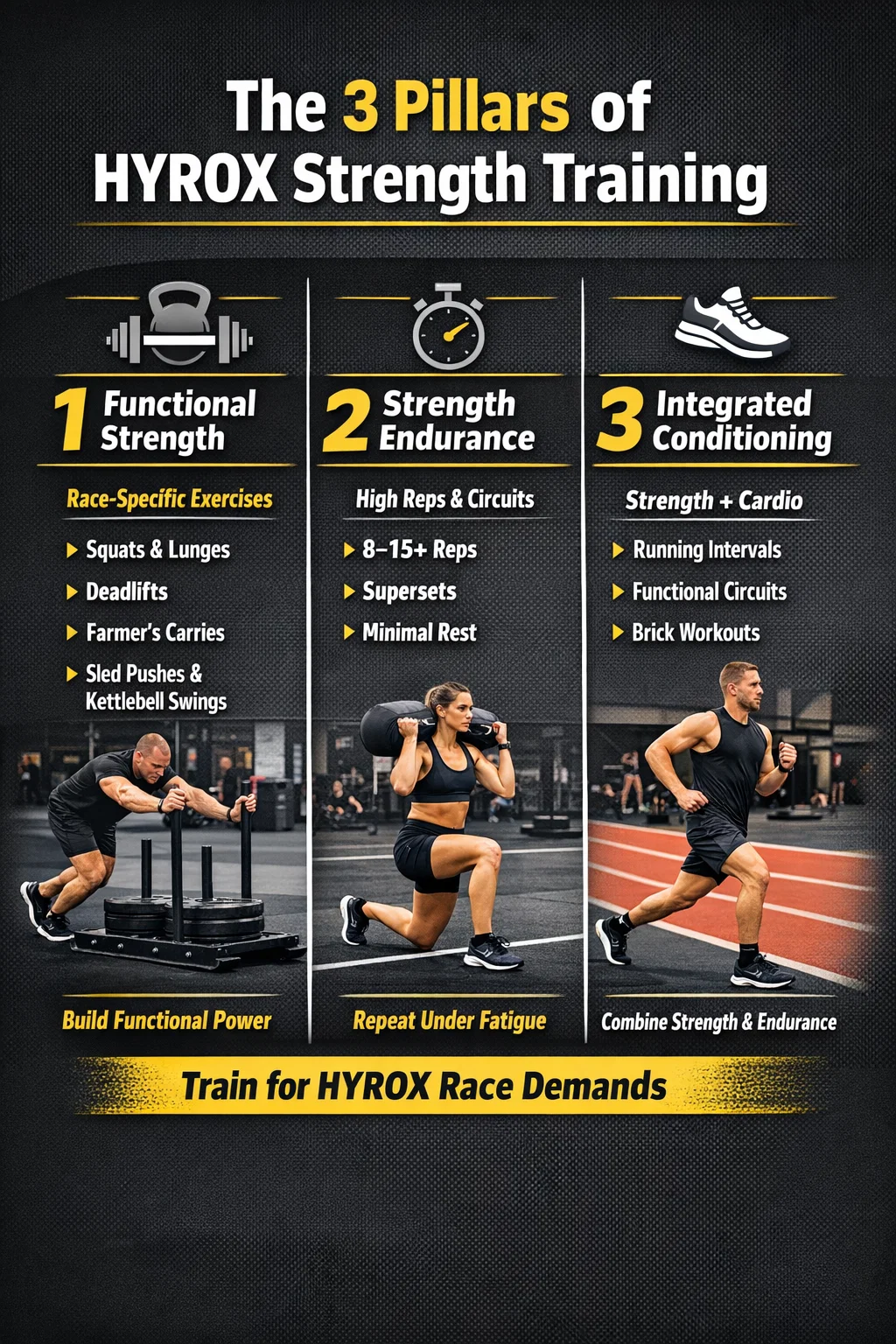
The 3 Pillars of HYROX Strength Training

An infographic showing the 3 pillars of HYROX strength training

Effective HYROX strength training combines three interconnected pillars:

1. Functional Strength

Focus on movements that replicate race mechanics, not just aesthetic or isolated lifts.

Key exercises include:

  • Squats and lunges — for lower body power
  • Deadlifts — for posterior chain strength
  • Farmer’s carries — for grip, core, and back endurance
  • Sled pushes/pulls — for sport-specific leg drive
  • Kettlebell swings — for explosive hip power and endurance

These transfers directly to sled work, sandbag lunges, and strength stations, especially under fatigue.

2. Strength Endurance

This isn’t about one-rep max. It’s about repeated reps under stress, the kind you’ll encounter after 3–4 runs.

Use:

  • Higher rep ranges (8–15+)
  • Supersets and circuits
  • Minimal rest between exercises

For example:

  • Back squat superset with walking lunges
  • Farmer carries followed by sled pushes
  • Deadlifts then burpee-broad jumps

This trains muscles to produce power repeatedly, not just once.

3. Integrated Conditioning

Since running accounts for about half of HYROX’s total demand, strength shouldn’t be isolated from aerobic work.

Integrate strength sessions with:

  • Running intervals
  • Functional circuits
  • Brick workouts (run + strength combo)

Doing strength after a run teaches your body how to produce force when oxygen is limited, exactly what race day requires.

Sample HYROX Weekly Training Plan

Below is a balanced weekly approach, developed by the experts at ChAIron that blends strength, endurance, power, and race-specific conditioning. This format is inspired by multiple expert plans and coaching recommendations for effective HYROX prep.

Monday — Lower Body Strength + Functional
  • Warm-up: 5–10 min row + dynamic mobility
  • Main lifts:
    • Back Squat 4×6–8
    • Bulgarian Split Squats 3×10/leg
  • Accessory:
    • Farmer’s Carry 3×40 m
    • Sled Push 3×20–30 m heavy
  • Core: Pallof press + dead bugs 3 sets

Focus: leg drive, posterior chain, carry endurance.

Tuesday — Run Intervals
  • 1 km warm-up jog
  • 6×1 km at race pace with 2 min rest
  • Cool-down run + mobility

Focus: pacing and aerobic capacity.

Wednesday — Active Recovery

Light movement: walking, cycling, yoga plus mobility focused on hips and thoracic spine.

Thursday — Upper Body & Explosive Strength
  • Warm-up: 5 min SkiErg
  • Deadlift 4×5
  • Pull-ups 4×6–10
  • Dumbbell bench press 3×8
  • Functional finisher:
    • 500 m Ski
    • 20 lunges
    • 15 burpees

Focus: pull strength, grip, and explosiveness.

Friday — Race Simulation Workout
  • 1 km easy run
  • 4 rounds:
    • 1 km run
    • Sled push 20 m
    • Sled pull 20 m
    • Minimal rest

Focus: transitions and compromised strength.

Saturday — Long Aerobic Run

45–60 min at conversational pace (Zone 2 heart rate). This builds stamina without excessive fatigue.

Sunday — Rest

Rest and recovery: sleep, mobility and foam rolling. This type of structure supports growth in strength and endurance, without sacrificing either.

Essential Strength Movements Explained

Not sure what to include? You can go through the ChAIron exercise library

But for your convenience, we have listed here some of the exercises that consistently show up in race-ready strength programs:

  1. Deadlifts: Build posterior chain power: essential for sled pushes and pulls. Learn how to properly do deadlifts here
  2. Squats: Develop leg strength and power for lunges and wall balls. Learn how to properly do squats here
  3. Farmers Carries: Supercharges grip strength, core stability, and functional strength. Learn how to properly do farmers carries here
  4. Walking Lunges: Mimic sandbag lunges and build single-leg stability. Learn how to properly do walking lunges here
  5. Sled Push: Integrating stability and strength motions trains your body for race-day conditions. Learn how to properly do sled push here

Training Mistakes That Steal Minutes

  1. Over-prioritising heavy lifting without aerobic context

Too much isolated strength training without running means your muscle strength won’t translate when tired.

  1. Neglecting recovery

Mobility, sleep, and nutrition are fundamental to strength gains, especially in hybrid events.

The ChAIron Edge in Strength Training

Unlike generic plans that simply list exercises, ChAIron’s approach:

  • Targets where strength drops under fatigue
  • Balances force production, pacing, and recovery
  • Helps you train like you’ll race, not like you wish you would
  • Adapts training based on your running endurance profile

When you build strength that thrives under stress, your performance turns predictable and personal bests become inevitable.

Frequently Asked Questions

1. How many days per week should I strength train for HYROX?


Most HYROX athletes benefit from 2–3 dedicated strength sessions per week, combined with 2–3 running or conditioning days. This balance builds functional strength and endurance without overloading your recovery.

2. Should I lift heavy or focus on high reps for HYROX?


HYROX rewards strength endurance, not one-rep max strength. Prioritize moderate loads, higher reps, and circuits that keep your heart rate elevated to mimic race-day fatigue and transitions.

3. Can beginners train for HYROX without sleds and race equipment?


Yes. You can substitute sleds with heavy lunges, farmer’s carries, step-ups, kettlebell swings, and resistance band pushes. The key is training force production under fatigue, not owning exact race gear.

4. How do I combine running and strength in the same workout?


Use “brick sessions,” where you alternate short runs with functional movements. For example: 800m run → lunges → sled push → 800m run. This trains your body to switch between aerobic and strength demands like race day.

5. How long does it take to build HYROX-specific strength?


Most athletes notice meaningful improvements in 6–8 weeks, with major performance gains after 12+ weeks of consistent hybrid training that blends running, functional strength, and proper recovery.

Strength That Wins Isn’t Built Fresh — It’s Built Tired

HYROX rewards athletes who can produce power when their heart rate is high and their legs are already heavy. By training functional strength, endurance, and integrated conditioning together, you prepare your body for the exact demands of race day. Stay consistent, respect recovery, and focus on strength that performs under pressure — not just in the gym.

Turn Workouts Into Race-Day Confidence

Stop guessing your training balance. ChAIron blends running, functional strength, and recovery into one smart system designed specifically for HYROX-style hybrid racing.

Master Your Fitness Journey – Read More