Why Leg Workouts Matter for Women
Ballerina legs.
Every woman loves to have these. But, strong legs aren't just about aesthetics. They're the foundation of functional fitness, athletic performance, and long-term health.
Leg training provides:
- Increased metabolic rate (leg muscles are the largest muscle groups, burning more calories)
- Improved bone density (critical for preventing osteoporosis)
- Better balance and injury prevention
- Enhanced athletic performance across all activities
- Functional strength for daily life (stairs, carrying groceries, playing with kids)
- Glute development that supports posture and lower back health
Many women avoid heavy leg training, worried about getting "bulky."
The reality?
Building significant muscle mass requires years of dedicated training, high calorie intake, and often genetic predisposition. What actually happens with smart leg training is you build lean, strong muscle that improves body composition and metabolic health.
This guide breaks down the top 10 leg exercises recommended by fitness experts, backed by research, and proven effective in both home and gym settings.
These movements target quads, hamstrings, glutes, and calves while addressing common priorities like glute emphasis, toning, and functional strength.
The Top 10 Best Leg Workouts for Women
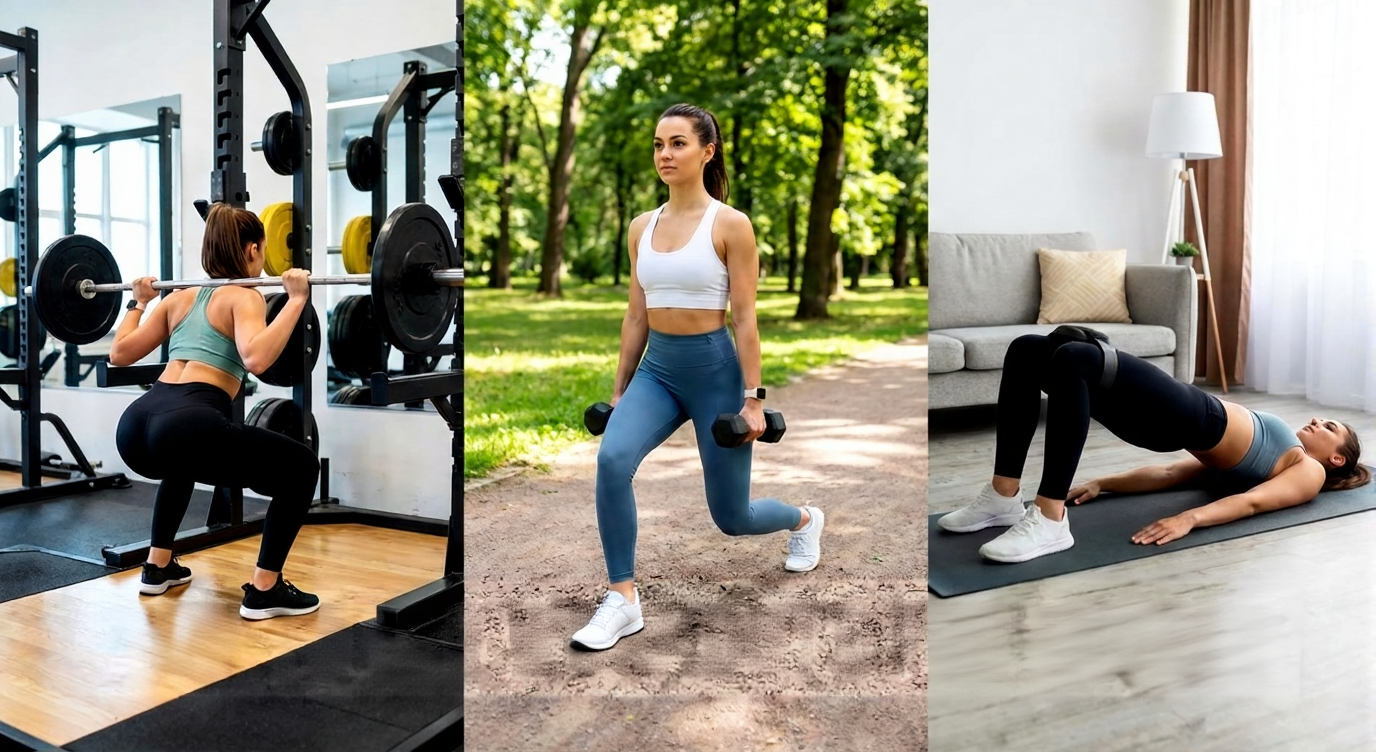
1. Back Squats (and Variations)
Primary muscles: Quads, glutes, hamstrings, core
Why it's essential: The squat is the foundational leg builder appearing in nearly every expert-recommended program. It's a compound movement that builds strength, muscle, and power across the entire lower body.
How to perform:
- Stand with feet shoulder-width apart, barbell across upper back (or bodyweight for beginners)
- Engage core, chest up, eyes forward
- Lower by pushing hips back and bending knees until thighs are parallel to ground (or deeper if mobility allows)
- Drive through heels to stand back up
- Keep knees tracking over toes, don't let them cave inward
Variations for different goals:
Goblet squats: Hold dumbbell or kettlebell at chest height. Perfect for beginners learning proper form or for home training.
Heel-elevated squats: Place small plates or wedge under heels. This variation emphasizes quads and allows deeper squat depth for those with limited ankle mobility.
Box squats: Squat down to a box or bench. Great for building strength from the bottom position and ensuring consistent depth.
Programming: 3-4 sets of 8-12 reps, 2-3 times per week
Common mistakes to avoid:
- Knees caving inward (knee valgus)
- Rising onto toes instead of keeping weight in heels
- Rounding lower back at bottom of squat
- Not reaching adequate depth
ChAIron tip: ChAIron's AI watches your squat depth, knee tracking, and back angle in real-time, correcting form errors before they become habits or cause injury.
2. Walking Lunges (and Lunge Variations)
Primary muscles: Quads, glutes, hamstrings, hip stabilizers
Why it's highly ranked: Lunges develop unilateral (single-leg) strength, fixing imbalances between legs while challenging balance and coordination. They're frequently praised for building toned legs without excessive bulk.
How to perform walking lunges:
- Stand tall, feet hip-width apart
- Step forward with right leg, lowering until both knees reach 90 degrees
- Front knee stays over ankle (not past toes), back knee nearly touches ground
- Push through front heel to step forward with left leg
- Continue alternating legs
Variations:
- Reverse lunges: Step backward instead of forward. Easier on knees and better for beginners.
- Forward stationary lunges: Stay in place, alternating which leg steps forward. Good for limited space.
- Bulgarian split squats: (See #5 for detailed breakdown, elevated rear foot increases difficulty)
- Walking lunges with dumbbells: Hold dumbbells at sides to increase resistance.
- Programming: 3 sets of 10-12 reps per leg, 2-3 times per week
Common mistakes:
- Front knee traveling too far past toes (increases knee stress)
- Leaning forward excessively
- Not lowering back knee close enough to ground
- Taking too short of steps
3. Romanian Deadlifts (RDLs)
Primary muscles: Hamstrings, glutes, lower back, core
Why it's recommended: RDLs are the top exercise for posterior chain development. They build strong hamstrings and glutes while teaching proper hip hinge mechanics, essential for injury prevention.
How to perform:
- Stand with feet hip-width apart, barbell (or dumbbells) held in front of thighs
- Slight bend in knees, chest up, shoulders back
- Push hips back while lowering weight down front of legs
- Feel stretch in hamstrings, keep back flat (no rounding)
- Lower until you feel maximum hamstring tension (usually mid-shin)
- Drive hips forward to return to standing, squeezing glutes at top
Key form points:
- Movement comes from hips, not from bending at waist
- Bar stays close to legs entire time
- Keep neck neutral (don't look up or down)
- Control the descent, don't just drop the weight
Variations:
- Single-leg RDLs: Perform on one leg for balance challenge and unilateral strength.
- Dumbbell RDLs: Use dumbbells instead of barbells. More accessible for home training.
- Programming: 3-4 sets of 8-12 reps, 1-2 times per week
Common mistakes:
- Rounding lower back (keep spine neutral)
- Bending knees too much (turns into squat)
- Not pushing hips back far enough
- Losing tension in hamstrings at top
ChAIron tip: ChAIron detects hip hinge mechanics and spinal position, flagging rounding before it causes lower back strain.
4. Hip Thrusts and Glute Bridges
Primary muscles: Glutes (maximus), hamstrings
Why it's essential: Often called the "best glute builder," hip thrusts and glute bridges specifically target glute development more effectively than squats alone. They're a staple in every glute-focused training program.
How to perform hip thrusts:
- Sit on ground with upper back against bench
- Place barbell (or dumbbell, or just bodyweight) across hips
- Plant feet flat on ground, knees bent
- Drive through heels, lifting hips until body forms straight line from shoulders to knees
- Squeeze glutes hard at top for 1-2 seconds
- Lower hips back down with control
How to perform glute bridges:
- Lie on back, knees bent, feet flat on floor
- Drive through heels, lifting hips toward ceiling
- Squeeze glutes at top
- Lower back down with control
Progression:
- Start with bodyweight glute bridges
- Add single-leg glute bridges
- Progress to barbell hip thrusts with light weight
- Gradually increase load
Programming: 3-4 sets of 10-15 reps, 2 times per week
Common mistakes:
- Hyperextending lower back at top (push hips up, not chest up)
- Not squeezing glutes at top position
- Using too much weight too soon (master form first)
- Pushing through toes instead of heels
5. Bulgarian Split Squats
Primary muscles: Quads, glutes, hip stabilizers
Why it's favored: This unilateral exercise fixes strength imbalances between legs while providing a serious quad and glute challenge. It's common in gym-based women's routines and delivers excellent results.
How to perform:
- Stand 2-3 feet in front of bench or elevated surface
- Place top of rear foot on bench behind you
- Lower down by bending front knee until thigh is parallel to ground
- Keep torso upright, front knee tracking over toes
- Drive through front heel to stand back up
- Complete all reps on one leg before switching
Setup tips:
- Find right distance from bench (too close or far affects form)
- Start with bodyweight until balance is mastered
- Hold dumbbells at sides or goblet-style at chest for added resistance
Programming: 3 sets of 8-12 reps per leg, 1-2 times per week
Common mistakes:
- Front knee caving inward
- Leaning too far forward
- Putting too much weight on back leg (should be 80-90% on front leg)
- Not lowering deep enough
ChAIron tip: ChAIron tracks your front knee alignment and torso position, ensuring balanced loading between legs.
6. Goblet Squats
Primary muscles: Quads, glutes, core
Why it's accessible: Goblet squats are a dumbbell or kettlebell variation ideal for home training or learning proper squat mechanics. The front-loaded weight naturally encourages upright torso position and deeper squat depth.
How to perform:
- Hold dumbbell or kettlebell vertically at chest, elbows pointing down
- Stand with feet slightly wider than shoulder-width
- Squat down, pushing knees out, keeping chest up
- Elbows should track between knees at bottom
- Drive through heels to stand
- Squeeze glutes at top
Why goblet squats teach good form:
- Weight position prevents excessive forward lean
- Encourages deep squat depth
- Easier to maintain balance than back squats
- Lower injury risk for beginners
Programming: 3-4 sets of 10-15 reps, 2-3 times per week
Progression:
- Start with light weight (10-15lbs)
- Gradually increase weight as form improves
- Progress to barbell squats once mechanics are solid
7. Step-Ups
Primary muscles: Quads, glutes, hip stabilizers
Why it's effective: Step-ups are a functional movement that mimics real-life activities (climbing stairs) while building single-leg strength and balance.
How to perform:
- Stand facing sturdy box or bench (height: knee to mid-thigh)
- Place entire right foot on box
- Drive through right heel to step up, bringing left foot to box
- Step back down with control (left foot first, then right)
- Complete all reps on one leg before switching, or alternate legs
Variations:
Bodyweight step-ups: Perfect for beginners or high-rep conditioning
Weighted step-ups: Hold dumbbells at sides for added resistance
Lateral step-ups: Step onto box from the side, targets different glute fibers
Box height considerations:
- Beginners: 12-16 inches
- Intermediate: 16-20 inches
- Advanced: 20-24 inches
Programming: 3 sets of 10-15 reps per leg, 1-2 times per week
Common mistakes:
- Pushing off bottom leg instead of using top leg
- Leaning forward excessively
- Using momentum instead of controlled movement
- Box too high (can't maintain good form)
8. Glute Kickbacks
Primary muscles: Glutes (maximus and medius)
Why it's included: Glute kickbacks are an isolation exercise that specifically targets glute development. They're popular in social media fitness content and deliver excellent shaping results when performed correctly.
How to perform cable glute kickbacks:
- Attach ankle strap to low cable pulley
- Face cable machine, slight forward lean, hands on machine for support
- Keep working leg straight (or slight knee bend)
- Kick leg back, focusing on squeezing glute at top
- Control return to start position
- Don't use momentum or swing leg
Bodyweight variation:
- Get on hands and knees (quadruped position)
- Keep right knee bent at 90 degrees
- Lift right leg, driving heel toward ceiling
- Squeeze glute at top
- Lower with control
Resistance band variation:
- Loop band around ankles
- Perform standing kickbacks against band resistance
Programming: 3 sets of 12-20 reps per leg, 1-2 times per week
Common mistakes:
- Arching lower back excessively (engage core)
- Using momentum instead of muscle contraction
- Not squeezing glute at top of movement
- Going too heavy and losing form
9. Calf Raises
Primary muscles: Calves (gastrocnemius and soleus)
Why it's consistent: Calf raises are essential for balanced leg development. While often overlooked, strong calves improve ankle stability, jumping ability, and overall lower leg aesthetics.
How to perform standing calf raises:
- Stand on elevated surface with balls of feet on edge, heels hanging off
- Rise up onto toes as high as possible
- Squeeze calves at top for 1-2 seconds
- Lower heels below platform level for full stretch
- Control the movement, don't bounce
Variations:
- Seated calf raises: Emphasizes soleus (lower calf muscle)
- Single-leg calf raises: Increases difficulty and addresses imbalances
- Smith machine calf raises: Allows heavy loading for strength building
- Programming: 3-4 sets of 15-20 reps, 2-3 times per week
Tips for better calf development:
- Full range of motion (high contraction, deep stretch)
- Pause at top and bottom of movement
- Train calves 2-3 times per week (they recover quickly)
- Vary rep ranges (some heavy 8-12 reps, some light 20-30 reps)
10. Sumo Squats (Plie Squats)
Primary muscles: Inner thighs (adductors), glutes, quads
Why it's ranked: Sumo squats specifically target the often-neglected inner thigh muscles while still working glutes and quads. They're frequently recommended for those seeking toned inner thighs and strong adductors.
How to perform:
- Stand with feet wider than shoulder-width, toes pointed outward 45 degrees
- Hold dumbbell or kettlebell with both hands hanging in front
- Lower down by bending knees, keeping torso upright
- Knees track in direction of toes
- Descend until thighs are parallel to ground
- Drive through heels to stand, squeezing glutes at top
Key form points:
- Keep knees pushing outward (don't let them cave in)
- Maintain upright torso (don't lean forward)
- Weight in heels and midfoot, not toes
- Full range of motion (deep squat)
Programming: 3 sets of 12-15 reps, 1-2 times per week
Common mistakes:
- Stance too narrow (loses sumo positioning)
- Knees caving inward
- Not descending deep enough
- Leaning forward excessively
How to Structure an Effective Leg Workout
Sample Leg Workout for Strength and Muscle Building
Warm-up (5-10 minutes):
- Foam rolling (quads, hamstrings, glutes)
- Dynamic stretches (leg swings, hip circles, walking lunges)
- Activation exercises (glute bridges, clamshells)
Main workout:
- Back Squats: 4 sets × 8-10 reps
- Romanian Deadlifts: 3 sets × 10-12 reps
- Bulgarian Split Squats: 3 sets × 10 reps per leg
- Hip Thrusts: 3 sets × 12-15 reps
- Calf Raises: 3 sets × 15-20 reps
Cooldown:
- Static stretching (hold each stretch 30-60 seconds)
- Focus on quads, hamstrings, hip flexors, calves
Sample Glute-Focused Leg Day
- Hip Thrusts: 4 sets × 10-12 reps (heavy)
- Romanian Deadlifts: 3 sets × 10 reps
- Walking Lunges: 3 sets × 12 reps per leg
- Glute Kickbacks: 3 sets × 15 reps per leg
- Sumo Squats: 3 sets × 15 reps
Sample At-Home Leg Workout (No Equipment)
- Goblet Squats (use filled backpack or heavy object): 4 sets × 15 reps
- Bodyweight Walking Lunges: 3 sets × 12 reps per leg
- Glute Bridges: 3 sets × 20 reps
- Step-Ups (using stairs): 3 sets × 12 reps per leg
- Single-Leg Calf Raises: 3 sets × 15 reps per leg
- Bodyweight Glute Kickbacks: 3 sets × 15 reps per leg
Training Frequency and Recovery
How often should you train legs?
- Beginners: 2 times per week with at least 48 hours between sessions
- Intermediate: 2-3 times per week, can split into separate focus days (quad-focused, glute-focused, hamstring-focused)
- Advanced: 3-4 times per week with varied intensities and rep ranges
Recovery considerations:
- Legs are large muscle groups requiring adequate recovery
- Soreness (DOMS) is normal, especially when starting or increasing intensity
- Include 1-2 rest days between leg sessions
- Active recovery (walking, light cycling, yoga) helps reduce soreness
- Prioritize sleep (7-9 hours) for muscle repair and growth
Progressive Overload: The Key to Continuous Results
To keep seeing results, you must progressively challenge your muscles. Progressive overload means gradually increasing the demands on your musculoskeletal system.
Ways to apply progressive overload:
- Increase weight: Add 5-10lbs when you can complete all sets with good form
- Increase reps: Aim for 12 reps instead of 10 with same weight
- Increase sets: Add an additional set to exercises
- Improve form: Deeper squats, slower tempo, better mind-muscle connection
- Reduce rest time: Shorter rest between sets increases metabolic demand
- Increase training frequency: Add an extra leg day per week
Track your workouts in a journal or app. If you're squatting the same weight for the same reps six months from now, you're not progressing.
Common Mistakes Women Make with Leg Training
Mistake 1: Using Weights That Are Too Light
Many women use weights far below their actual capacity, worried about getting bulky. The result? No progress, no muscle development, minimal calorie burn.
The fix: Choose weights that make the last 2-3 reps of each set challenging while maintaining good form. If you can easily do 15 reps, the weight is too light.
Mistake 2: Skipping Compound Movements
Some women focus exclusively on isolation exercises (kickbacks, leg extensions) while avoiding heavy compound movements (squats, deadlifts).
The fix: Prioritize compound movements (squats, deadlifts, lunges) that work multiple muscle groups. Add isolation work after, not instead of, compounds.
Mistake 3: Not Training Heavy Enough
Building strong, toned legs requires challenging loads. Sticking to light weights and high reps (20+ reps) builds endurance but limited muscle.
The fix: Include sets in the 8-12 rep range with weights that challenge you. This rep range optimizes muscle growth.
Mistake 4: Neglecting Progressive Overload
Doing the same workout with the same weights month after month produces no new adaptation.
The fix: Track your workouts and progressively increase demands (more weight, more reps, more sets, better form).
Mistake 5: Poor Form and Range of Motion
Quarter squats, shallow lunges, and abbreviated range of motion limit muscle activation and increase injury risk.
The fix: Prioritize full range of motion with proper form over heavy weight with poor execution.
ChAIron tip: ChAIron's real-time form analysis catches shallow squats, knee valgus, and incomplete range of motion—correcting issues before they become habits.
Nutrition to Support Leg Training and Results
Training is only half the equation. Nutrition determines whether you build muscle, lose fat, and recover properly.
Protein requirements:
- Aim for 0.7-1g protein per pound of body weight daily
- Distribute protein across 4-5 meals (20-40g per meal)
- Include protein post-workout for muscle repair
Carbohydrate needs:
- Carbs fuel high-intensity leg training and support recovery
- Don't fear carbs when training legs hard
- Time carbs around training (pre and post-workout)
Hydration:
- Dehydration impairs performance and recovery
- Drink half your body weight in ounces daily
- Add 16-24oz per hour of training
Post-workout nutrition:
- 20-40g protein within 60-90 minutes after training
- Carbs to replenish glycogen (0.5-1g per kg body weight)
- Example: Protein shake with banana, Greek yogurt with berries
Ready to Perfect Your Leg Training with AI Coaching?
These 10 leg exercises deliver real results when performed with proper form, progressive overload, and consistency. But knowing which exercises to do is only part of the equation. Executing them correctly determines whether you build strength or develop injury.
ChAIron's AI coaching watches your leg training in real-time, correcting form on squats, lunges, deadlifts, and every movement in this guide. Get instant feedback on depth, alignment, and technique, ensuring every rep builds strength, not compensation patterns.
Whether you're training at home with minimal equipment or in a fully equipped gym, ChAIron adapts your leg programming based on your performance, recovery, and goals.
Download ChAIron and get your first 7 days free
Stop guessing if your form is right. Start training legs with AI coaching that watches every rep and builds the strong, functional lower body you're working for.

.png)
.png)